Kunshan Chuanna Hydraulic Parts Co., Ltd
——"certified products manufacturer"——-
QR code

-
Official Account

-
Shop code


QR code
Official Account
Shop code

Kawasaki agent tells you why the new excavator diesel engine is overheating?
1. Overheating phenomenon
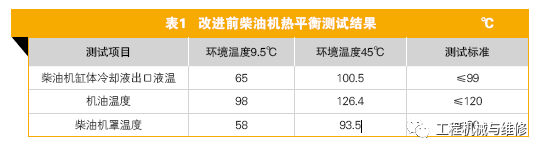
Before leaving the factory, the hydraulic excavator must undergo a thermal balance test during diesel engine operation. The method is as follows: fully open the throttle of the diesel engine and allow the excavator arm and boom to "hold pressure" and overflow, in order to simulate the operating temperature of the diesel engine at full load. Our test results on a certain type of hydraulic excavator prototype show that the diesel engine equipped with the excavator has a high temperature under full load, and its thermal balance test results are shown in Table 1. Kawasaki agent for excavator accessories
From the test results, it can be seen that at an ambient temperature of 45 ℃, the coolant outlet temperature, oil temperature, and diesel engine chamber temperature of the diesel engine cylinder block are all higher. This indicates that the excavator will exhibit diesel engine overheating when operating in a 45 ℃ environment (environmental limit temperature).
2. Analyze the causes of overheating in diesel engines
Hydraulic excavator diesel engine overheating may be caused by two reasons: firstly, there is a problem with the diesel engine, resulting in excessive heat generation, and secondly, the cooling system lacks heat dissipation. When testing the prototype, the diesel engine was in good condition, so the cause of overheating should be a lack of heat dissipation. The heat dissipation of a diesel engine primarily relies on the radiator, and the heat dissipation of the radiator mainly depends on the amount of air passing through the radiator core. Therefore, improving the function of the cooling fan can effectively enhance the heat dissipation capability of the radiator.
The improvement of cooling fan function can be achieved through the following three plans: first, increasing the diameter of the fan, second, increasing the fan speed, and third, reducing the gap between the fan blade tip and the fan coil. The diesel electric fan is directly driven by the front belt pulley, with the same speed as the diesel engine, and the fan speed cannot be increased. Increasing the diameter of the electric fan requires replacing the radiator with a larger scale and arranging the diesel engine from scratch, which is difficult to implement. In addition, methods such as increasing the fan speed and enlarging the fan diameter will increase the power consumption of the diesel engine, so both the first and second plans are not feasible. After summarizing and considering, it is believed that the plan to reduce the gap between the fan blade tip and the wind coil by adjusting the size of the air guide cover is more convenient and useful. Kawasaki agent
3. Analyze the relationship between blade tip clearance and exhaust air volume
Using an anemometer to measure the wind speed on the inlet side of the radiator, it was found that the wind speed in a single area on the inlet side of the radiator was very low, only about 1m/s, indicating that the fan's blowing function was poor.
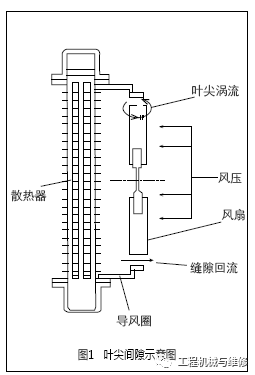
In theory, there are two types of air activity in the gap area of the fan blade tip: one is the pressure difference between the fan outlet and inlet, which drives the airflow at the fan outlet to flow back along the gap between the fan blade tip and the wind coil towards the inlet; Secondly, there is a pressure difference between the blade pressure surface and the suction surface, which drives the airflow to wrap around the gap between the fan blade tips and form vortices, as shown in Figure 1. The conflicts, impacts, and vortex losses caused by the two types of air activities mentioned above can directly lead to a decrease in fan exhaust volume and operational efficiency. Therefore, appropriately reducing the diameter of the air guide ring and minimizing the gap between the fan blade tips can reduce gap backflow and blade tip eddy currents, effectively improving the fan exhaust volume and operational efficiency.
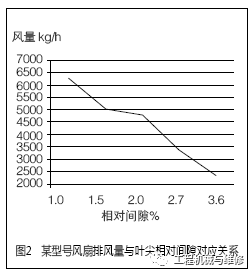
A certain experimental organization once used a fan with a wind pressure of 400Pa to blow air into the radiator. The corresponding relationship between the fan exhaust volume and the relative clearance between the blade tips (the ratio of the blade tip clearance to the fan diameter) was measured and shown in Figure 2. From the curve in Figure 2, it can be seen that as the relative gap increases from 1% to 1.5%, the exhaust volume of the electric fan decreases rapidly; When the relative gap increases from 1.5% to 2%, the decrease in fan exhaust volume tends to be steep. When the relative gap increases from 2% to 3.6%, the fan exhaust volume sharply decreases, and the trend of air volume decrease is more significant.
The diameter of the diesel electric fan of the excavation engine is 550 mm, the inner diameter of the air guide ring of the air guide cover is 590mm, and the average clearance between the blade tips is 20mm. Therefore, the relative clearance of the electric fan is calculated to be 3.6%. Referring to the curve in Figure 2, it can be determined that if the relative gap is slightly reduced from the current 3.6%, the exhaust volume of the electric fan will increase significantly.
4. Improvement methods
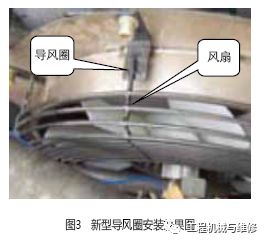
At the beginning, it was decided to change the inner diameter of the air guide ring of the diesel engine radiator air guide cover from 590mm to 580mm (with a blade tip clearance of 15mm). The new air guide ring device is shown in Figure 3. After improvement, the relative clearance between the blade tips of the electric fan is 2.7%. As shown in Figure 2, there will be a significant increase in the fan's air volume. Kawasaki agent
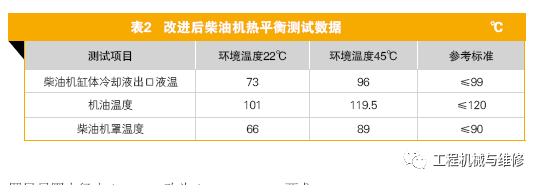
To verify the improvement effect, a thermal balance test was conducted on the diesel engine again, and the test data is shown in Table 2.
From Table 2, it can be seen that after changing the blade tip clearance and relative clearance, the diesel engine outlet temperature, oil temperature, and diesel engine hood temperature decreased by 5.5 ℃, 6.9 ℃, and 4.5 ℃ respectively at an ambient temperature of 45 ℃, and all met the test specification requirements.
The relationship between blade tip clearance and overall thermal equilibrium temperature is quite complex. In practical applications, the improvement of overall thermal equilibrium is closely related to many factors such as air duct structure, fan viewpoint, number of fan blades, fan projection area, fan shape, etc. Only the change of blade tip clearance has a more significant impact on thermal equilibrium. Kawasaki agent
 Company Address: No. 379, Junjin Road, Zhangpu Town, Kunshan City
 Contact: Mr. Chen
 Phone:18112623390
 landline:0512-36863852