Kunshan Chuanna Hydraulic Parts Co., Ltd
——"certified products manufacturer"——-
QR code

-
Official Account

-
Shop code


QR code
Official Account
Shop code

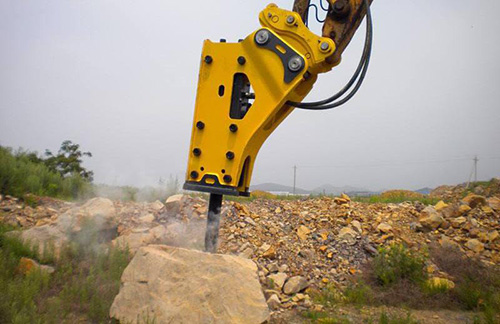
A commonly used tool on excavators in the crushing hammer market is primarily used in mines, bridges, and urban construction. Due to the harsh operating conditions of the crushing hammer, there are stricter requirements for the quality and device application of the crushing hammer. The following are the application methods summarized by Kawasaki agents for our reference:
1. Regularly check the pressure and flow rate of the crushing system, and whether the nitrogen is sufficient. It is best to add a crushing hammer return oil filter behind the excavator accessory arm shaft pin, that is, to the rotating pump. The replacement time of the hydraulic oil inlet and return filter element should be halved.
2. When pouring cement and dead mountains, do not blindly push down the hammer and chisel, as it is very easy to break the hammer and chisel. Instead, stop the big hammer from digging halfway into the mountain, clean the floating material first, and then continue.
3. When breaking the block, try to push the hammer forward slightly with a big hammer, so that most of the stone blocks will fly forward, maintaining the glass and car.
4. Adjust the impact frequency of the breaking hammer according to the situation. For example, for small stones and cement blocks, the frequency can be increased. For larger blocks or dead materials (such as mountain roots), adjusting the frequency appropriately can improve work efficiency.
5. As the hammer strikes this stone, one must think carefully about the next course of action and locate the surface of the hammer.
6. Secondly, do not press the hammer too firmly, and of course, do not use an empty hammer. Simply align the hammer drill with the stone and press it into the inner sleeve, then press it firmly. Do not lift all the tracks of the excavator parts, as the stone will be thrown down forcefully, which is not good for the vehicle.
7. When firing, Kawasaki agents remind you to place the excavator steadily to minimize shaking and improve the accuracy of the hammer.
8. Similar to before driving a car, it is necessary to inspect the vehicle around the breaking hammer before construction. Firstly, check if the high and low pressure hoses of the breaker are loose, and also check if there are any oil leaks in other areas.
9. Check if the bolts are loose; Whether the connecting pins of excavator accessories are excessively worn; Check if the gap between the drill rod and its liner is normal, and if there is any oil leakage between them. It should be clarified that the low-pressure oil seal is damaged and should be replaced by a professional.
10. Smooth the smooth points of the working device before and after 2-3 hours of continuous operation.
11. The change in hydraulic oil quality varies depending on the working environment. A simple way to determine the quality of oil is to investigate the color of the oil. When the oil quality deteriorates severely, the oil should be drained and new oil should be injected after cleaning the oil tank and filter.
Kawasaki agent friendly reminder: The scale types of the hammer are complex, and it is necessary to choose the appropriate one during the use of the device. Once a problem occurs, it is recommended to seek professional personnel for troubleshooting and repair. As a large item, its repair cost is not low, and regular maintenance can also effectively reduce the incidence of accidents.
 Company Address: No. 379, Junjin Road, Zhangpu Town, Kunshan City
 Contact: Mr. Chen
 Phone:18112623390
 landline:0512-36863852