Kunshan Chuanna Hydraulic Parts Co., Ltd
——"certified products manufacturer"——-
QR code

-
Official Account

-
Shop code


QR code
Official Account
Shop code

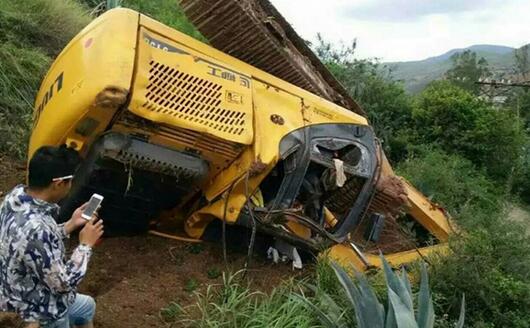
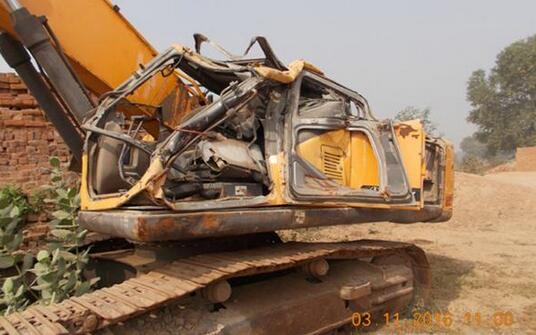
When choosing a second-hand mining machine, the biggest fear for buyers is encountering an accident car. The body structure of vehicles that have experienced severe incidents has undergone severe deformation, and even after correction, there may still be multiple hidden injuries remaining. The probability of problems occurring during future operations is very high. Therefore, Chuan Na, a supplier of excavator parts from Shengang, has specially summarized some techniques for identifying the involved vehicles to assist everyone in avoiding this trap.
Firstly, it should be noted that the incident vehicle mentioned here refers to severe incidents that have caused deformation of the excavator, such as severe collisions and rollovers. Minor collisions and rollovers are not included in this category.
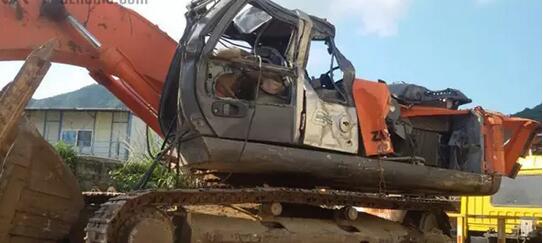
When a serious incident occurs with an excavator, there are usually traces of deformation left on the exterior, paint, glass, interior, and important structural components. Even if the correction techniques are superb, a few clues can still be found from them. Therefore, Chuanna, a supplier of excavator parts for Shengang, believes that the identification of the involved vehicle should mainly focus on these parts, such as appearance, paint surface, glass, interior, and structural components.
1. Check the cabin
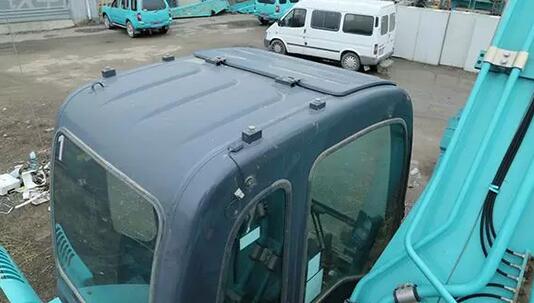
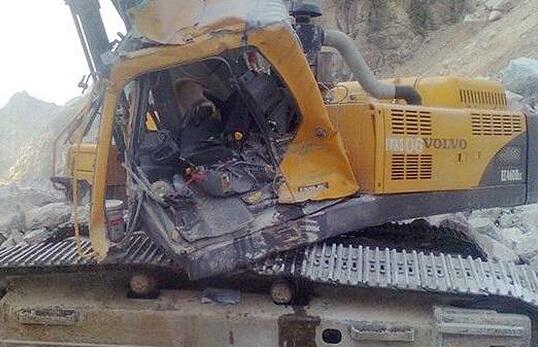
When dealing with incidents such as stone smashing and rolling, the driver's cabin takes the lead. If the top and side paint surfaces of the driver's cabin fall off severely, or if they have been repainted from scratch, it is suspected that there is a vehicle being driven. The stamping parts of the original control room have many curves and complex structures, making it difficult to correct the sheet metal in the later stage. The corrected control room can be seen at the top with a few more glances.
If the cabin is severely damaged, the four side glass and interior of the cabin must also be replaced due to damage. When the four side windows of the driver's cabin do not match the production date of the entire vehicle, or when there are significant differences between the old and new interiors, it is necessary to be careful in discerning.
If the driver's cabin of the incident vehicle no longer has the conditions for correction and the overall vehicle handling is relatively high, innovators usually replace the incident vehicle with a new driver's cabin. But regardless of whether the new or old cabin is replaced, the clues can be easily seen.
(1) The paint color is not the same as the car body. The paint color of the car body will definitely change during the use of the excavator. If you change to a new cabin, the paint color will definitely be different.
(2) The date of the driver's cabin glass is common but does not match the production date of the entire vehicle: new driver's cabin glass is generally used from the same batch, so the production date will also be common, but there will inevitably be significant differences from the actual production date of the entire vehicle. Be careful and make a simple judgment.
2. Check the size arms and frame
When the excavator experiences a rollover or rolling incident, the external frame, large and small arms, and other components are prone to severe damage and deformation under external force. After adjusting the excavator, stand at the main control valve to see if there is any tilt angle of the large and small arms.
Severe overturning, deformation, misalignment, and damage of components such as the frame and hydraulic system engine. At this time, it is necessary to check whether there are paint marks on the exterior components such as the X-frame, large and small arms, control cabin, and side doors, and whether the joints of each component are too large or uneven.
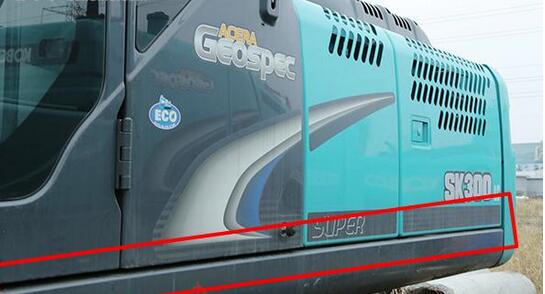
3. Check the anti-collision beam and edge beam
The anti-collision beam and edge beam are the outermost protective devices of the excavator. When an accident occurs, the anti-collision beam and edge beam are the easiest parts to be damaged. If the collision beam and side beam are "damaged", this car must be the accident car.
How to check if the collision beam and edge beam have been damaged? Simply put, it means: looking from a distance and up close
From a distance: When inspecting a second-hand excavator, first investigate whether the collision beam and edge beam are smooth from 10 meters away, and whether there is any change in the reflectivity of the paint surface. If it is a damaged and corrected edge beam, traces can be exposed in terms of smoothness and reflectivity.
Close up: Regarding popular models of excavators, there are brand new side beams and anti-collision beam accessories for sale in the mall, which require careful investigation nearby. Firstly, look at the gaps between the side beams and the cover parts of the upper body. The gaps in the car that have not experienced the incident must be uniform and will not show significant changes in width. Secondly, check if there are any welds on the inner side of the edge beam. The corrected edge beam usually only needs to be treated externally, and the cost and difficulty of treating the inner side are too high. Most repair personnel would not do this, which is also a path left for us to check.
4. Check the X frame
If a mining machine has experienced a severe overturning incident, then the X-frame of this car is likely to have already deformed, and the cost of repairing and replacing the X-frame is high. The traces of timely correction are also quite noticeable.
If the degree of deformation of the X frame does not affect its use, innovators usually use methods such as "sticking mud" or painting to cover it up. This requires quickly sorting the mud and checking it out.
If the deformation of the equipment is severe but has certain correction value, innovators usually carry out correction processing. Correcting the appearance marks of the X frame in the future will be more noticeable, with wavy correction marks appearing briefly at the edges of some deformed parts of the X frame.
When an accident occurs with the accessories of a Shengang excavator, the hatch on the same side is easily damaged
5. Check the cabin door
The door of the excavator is a vulnerable part that can be easily bumped or damaged during daily construction. It is normal to make sheet metal corrections or replacements for aesthetic purposes, so this cannot be used as a direct basis for determining whether an excavator is an accident vehicle. However, it can be used as an indirect "basis".
When you doubt through other methods that this is an incident vehicle, you can use the orientation of the cabin door to assist in discrimination. For example, if you find that all the glass on one side of the cabin has been replaced and there are traces of correction on the side beams, and also verify that the cabin door on the same side has been corrected, the supplier of excavator parts from Shengang, Chuanna, feels that at this moment, it can be concluded that an incident has occurred.
 Company Address: No. 379, Junjin Road, Zhangpu Town, Kunshan City
 Contact: Mr. Chen
 Phone:18112623390
 landline:0512-36863852